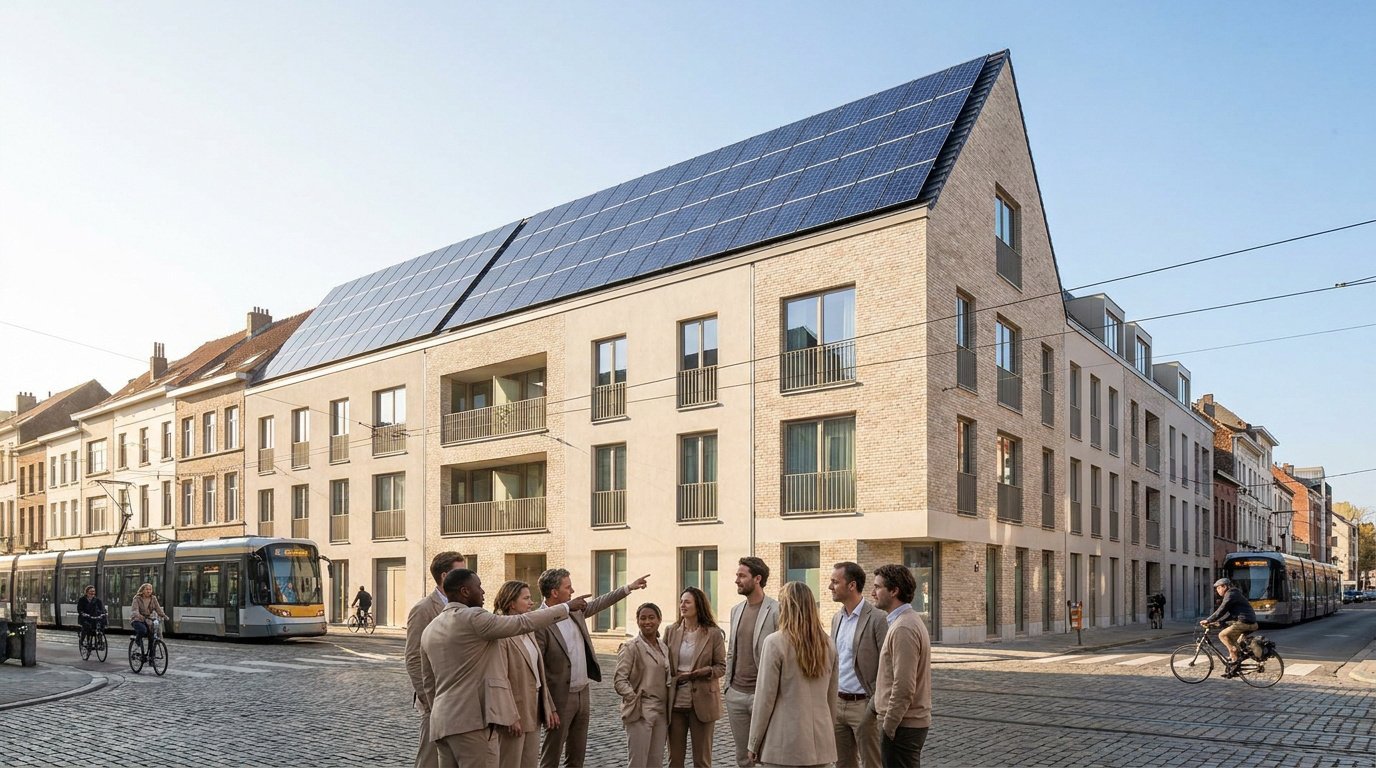
Im Miteigentum liegt die Schwierigkeit nicht in der Technik: sie ist rechtlicher und kollektiver Natur. Das Dach ist grundsätzlich ein Gemeinschaftsteil (sein Status ergibt sich aus der Basisurkunde oder, wenn diese nichts sagt, aus dem Gesetz); die Entscheidung fällt in der Generalversammlung, und wenn der erzeugte Strom nicht nur den Gemeinschaftsteilen dient, muss er auf Haushalte verteilt werden, die nicht zur gleichen Zeit verbrauchen. Diese Seite beschreibt den gesamten Weg, von der Aufnahme in die Tagesordnung bis zum Netzanschluss. Die Regeln für die gemeinsame Nutzung von Energie hängen von der Region ab: Die Wallonie und Brüssel werden hier ausführlich behandelt; für Flandern lesen Sie die Seite von vlaanderen.be zur gemeinsamen Nutzung von Energie in einem Mehrfamilienhaus (auf Niederländisch).
Die gemeinsame Nutzung von Energie zwischen den Bewohnern desselben Gebäudes ist in allen drei Regionen (Wallonie, Brüssel und Flandern) geregelt, jeweils mit eigenen Regeln. Dafür muss keine Energiegemeinschaft gegründet werden: Energiegemeinschaften sind eine eigene Form, gedacht für eine gemeinsame Nutzung in größerem Maßstab, etwa auf Ebene eines Viertels. In der Praxis kann die Installation von Solaranlagen im Miteigentum in Belgien wie eine administrative Herausforderung wirken: Die erforderliche Mehrheit muss in der Generalversammlung erreicht werden, und die Frage etwaiger Grünstromzertifikate muss geklärt werden. Sie stehen dem Erzeuger der Anlage zu, der klar zu bestimmen ist (das Miteigentum oder der Miteigentümer, der investiert hat). Ihr Vorhaben kann wegen der Zweifel Ihrer Nachbarn oder wegen Unsicherheiten bei der Finanzierung ins Stocken geraten.
Dieser Artikel klärt den aktuellen rechtlichen Rahmen und die Modalitäten der Kostenverteilung, um Ihnen zu helfen, die Abstimmung und die Ausgestaltung Ihrer gemeinschaftlichen Anlage vorzubereiten. Wir gehen die wichtigsten Schritte durch, von der Abstimmung der Miteigentümer bis zur Verwaltung der Zähler.
Der rechtliche Rahmen für Solaranlagen im Miteigentum in Belgien
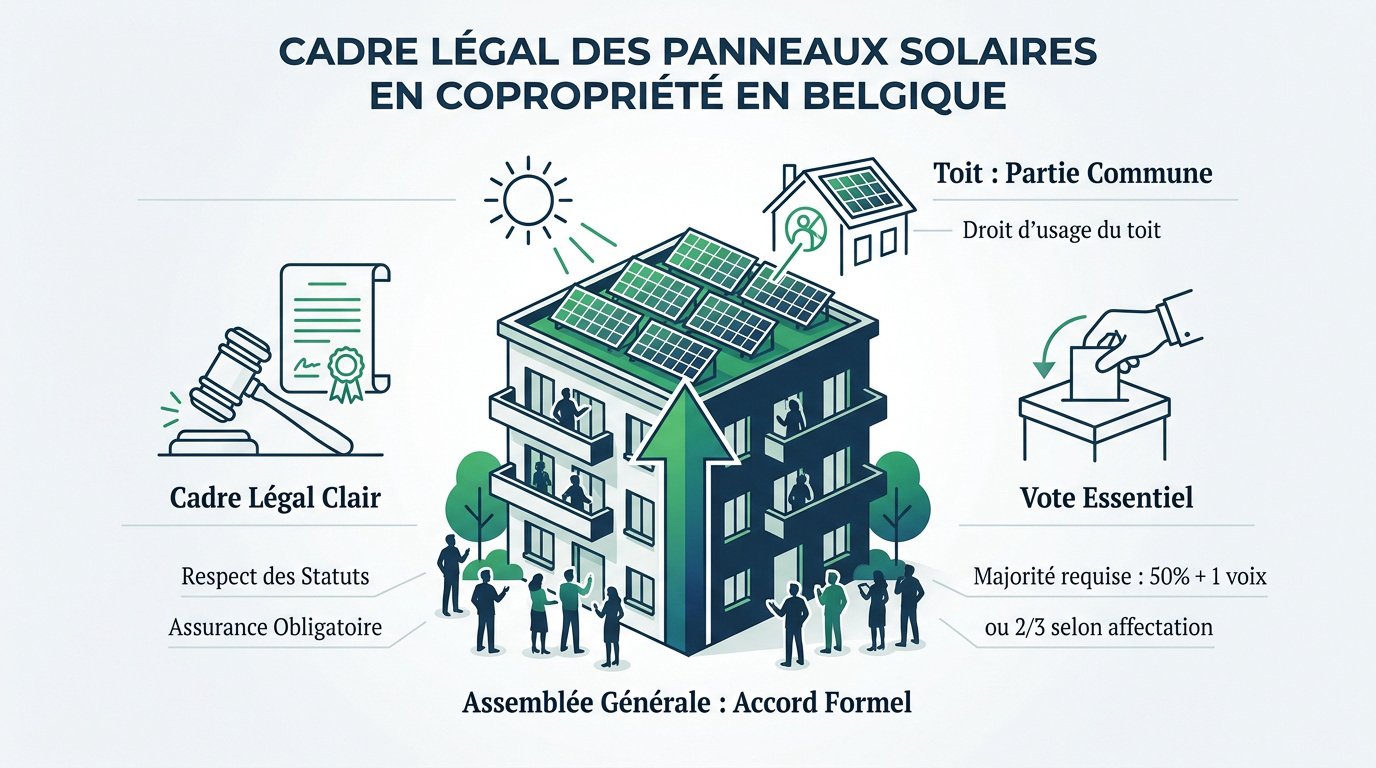
In Belgien erfordert eine Photovoltaikanlage im Miteigentum grundsätzlich einen Beschluss der Generalversammlung mit einer Mehrheit von zwei Dritteln, denn das Anbringen von Modulen auf dem gemeinsamen Dach ist eine Arbeit, die die Gemeinschaftsteile betrifft (Art. 3.88 des belgischen Zivilgesetzbuches). Das Dach ist grundsätzlich ein Gemeinschaftsteil: Die Basisurkunde legt seinen Status fest, und wenn sie nichts sagt, vermutet das Gesetz, dass die Teile, die dem Gebrauch aller Miteigentümer dienen, gemeinschaftlich sind (Art. 3.84 des belgischen Zivilgesetzbuches). Module darauf anzubringen, ob sie einer einzelnen Einheit oder dem ganzen Gebäude dienen, erfordert daher in der Regel einen Beschluss der Generalversammlung; das Gesetzbuch sieht jedoch ein eigenes Verfahren für bestimmte energiebezogene Einrichtungen vor, die auf Kosten eines Miteigentümers angebracht werden (Artikel 3.82 § 2), siehe unten.
Die Zustimmung der Generalversammlung der Miteigentümer erhalten
Arbeiten, die die Gemeinschaftsteile betreffen, wie das Anbringen von Modulen auf dem gemeinsamen Dach, werden grundsätzlich mit einer Mehrheit von zwei Dritteln der Stimmen beschlossen (Art. 3.88 des belgischen Zivilgesetzbuches); Enthaltungen sowie leere oder ungültige Stimmen werden nicht mitgezählt. Die Versammlung ist nur beschlussfähig, wenn das Quorum erreicht ist: Mehr als die Hälfte der Miteigentümer ist anwesend oder vertreten und hält zusammen mindestens die Hälfte der Anteile, oder die anwesenden oder vertretenen Miteigentümer halten mehr als drei Viertel der Anteile. Andernfalls wird mindestens fünfzehn Tage später eine zweite Versammlung einberufen, die ohne Quorum beschließen kann.
Sie müssen den Verwalter bitten, Ihr Vorhaben auf die Tagesordnung zu setzen. Senden Sie ihm Ihren Vorschlag schriftlich: Er setzt ihn auf die Tagesordnung der ordentlichen Generalversammlung, wenn er ihn mindestens drei Wochen vor Beginn des in der Hausordnung festgelegten Versammlungszeitraums erhält. Geht er später ein, wird er auf die Tagesordnung der nächsten Versammlung gesetzt.
Grundsätzlich zwei Drittel der Stimmen für Arbeiten, die die Gemeinschaftsteile betreffen, wie das Anbringen von Modulen auf dem gemeinsamen Dach (Art. 3.88 des belgischen Zivilgesetzbuches). Enthaltungen sowie leere oder ungültige Stimmen werden nicht mitgezählt.
Unterscheiden Sie bei der Abstimmung klar zwischen dem gemeinschaftlichen Vorhaben und der rein privaten Nutzung. Achten Sie stets auf die Übereinstimmung Ihres Antrags mit der Satzung, die für Ihr Miteigentum gilt.
Nutzungsrecht am Dach und Abgrenzung der Gemeinschaftsteile
Prüfen Sie in Ihrer Basisurkunde den rechtlichen Status des Daches. Die Gemeinschaftsteile stehen im erzwungenen Miteigentum: Jede Einheit umfasst einen privaten Teil und einen Anteil an den gemeinschaftlichen Teilen (Artikel 3.78 und 3.84 des belgischen Zivilgesetzbuches), was jede isolierte persönliche Initiative einschränkt.
Ein ausschließliches Nutzungsrecht am Dach gilt für sich allein nicht als Genehmigung für Arbeiten: Das Dach bleibt ein Gemeinschaftsteil, und Arbeiten daran erfordern grundsätzlich einen Beschluss der Generalversammlung (Artikel 3.85 und 3.88 des belgischen Zivilgesetzbuches). Dieses Recht befreit auch nicht von einer etwaigen Baugenehmigung (siehe FAQ).
In der Regel erfordert das Anbringen von Modulen auf dem gemeinsamen Dach, ob sie einer einzelnen Einheit oder dem ganzen Gebäude dienen, einen Beschluss der Generalversammlung (Artikel 3.88 des belgischen Zivilgesetzbuches). Artikel 3.82 § 2 des belgischen Zivilgesetzbuches sieht jedoch ein eigenes Verfahren für bestimmte energiebezogene Einrichtungen vor, die auf Kosten eines Miteigentümers angebracht werden: Fragen Sie Ihren Verwalter oder einen Notar, ob es auf Ihr Vorhaben anwendbar ist.
Informieren Sie vor dem Anbringen den Versicherer des Gebäudes, um zu prüfen, ob die Anlage durch die Police des Miteigentums gedeckt ist.
Wer finanziert und wer profitiert von der erzeugten Energie?
Ist der rechtliche Teil geklärt, bleiben zwei getrennte Fragen: Wer finanziert die Anlage, und wer verbraucht den erzeugten Strom?
Verteilung der Installationskosten auf die einzelnen Einheiten
Finanziert das Miteigentum die Anlage, trägt jeder Miteigentümer nach dem Kostenverteilungsschlüssel der Miteigentumsordnung bei: grundsätzlich nach dem jeweiligen Wert der Einheiten, auf dem auch die Anteile beruhen, es sei denn, die Ordnung sieht ein Nützlichkeitskriterium vor, allein oder in Verbindung mit dem Wert (Artikel 3.80 und 3.81 des belgischen Zivilgesetzbuches).
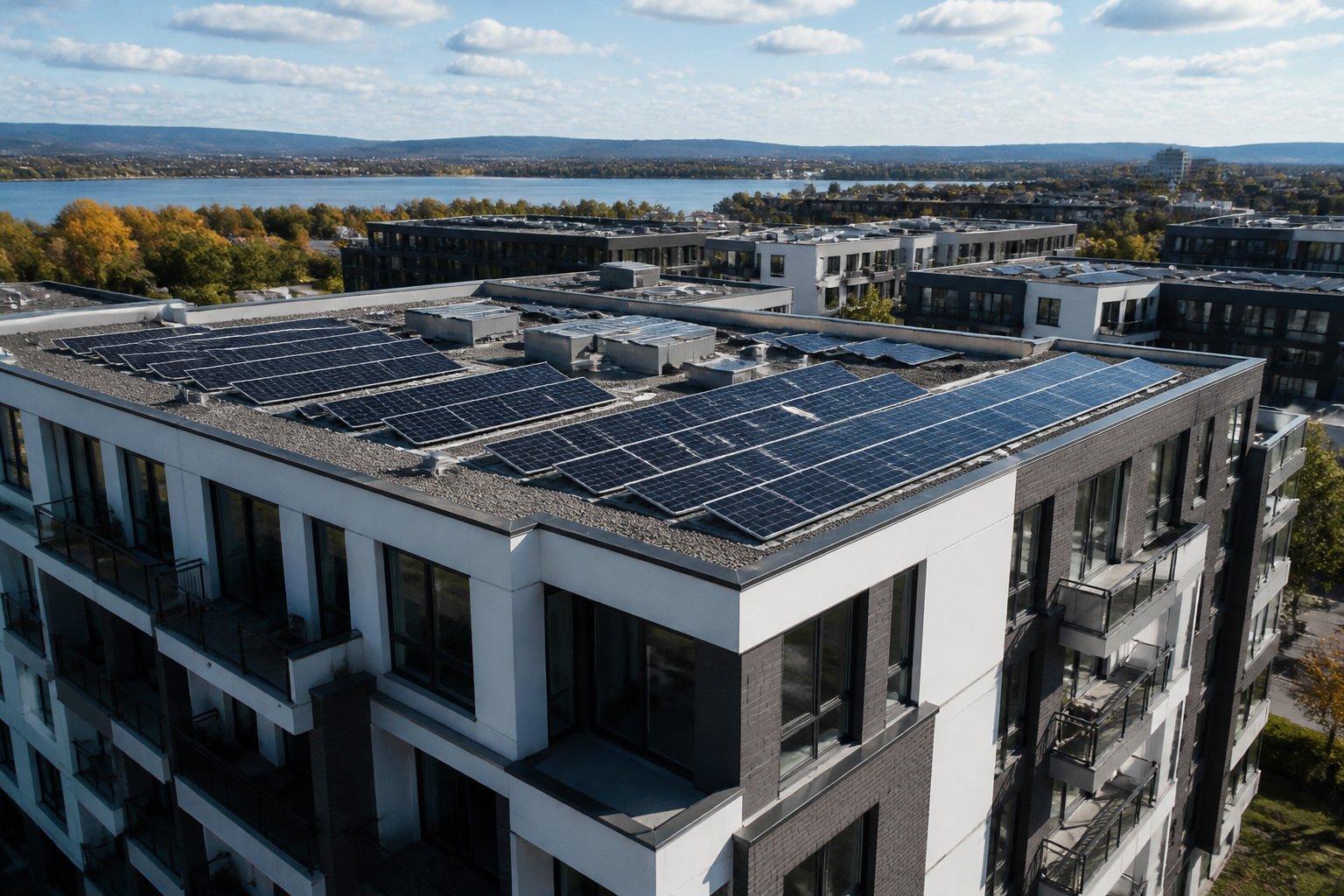
Beschließt die Generalversammlung eine gemeinsame Anlage, bindet dieser Beschluss alle Miteigentümer, auch diejenigen, die dagegen gestimmt haben, und die Kosten folgen dem Kostenverteilungsschlüssel. Finanzierung und Erzeugung nur bestimmten Miteigentümern vorzubehalten, setzt grundsätzlich einen eigenen Beschluss der Generalversammlung voraus, mit der Mehrheit, die Artikel 3.88 des belgischen Zivilgesetzbuches je nach Art der Änderung vorsieht. Das Gesetzbuch sieht außerdem das Verfahren nach Artikel 3.82 § 2 für bestimmte energiebezogene Einrichtungen vor sowie die Anrufung des Richters, wenn sich die Generalversammlung ohne triftigen Grund nützlichen Arbeiten widersetzt, die ein Miteigentümer allein finanzieren will (Artikel 3.92 § 5).
Fordern Sie für den Start Ihres Vorhabens eine persönliche Solarstudie an. Sobald das Vorhaben von der Generalversammlung genehmigt ist, führt der Verwalter den Beschluss aus und kümmert sich um die entsprechenden Mittelabrufe.
Je nach gewählter Variante kann es sich unter anderem um eine gemeinsame Anlage handeln, die am Zähler der Gemeinschaftsteile angeschlossen ist, oder um mehrere Einzelanlagen, jede mit eigenem Wechselrichter und am Zähler einer Wohnung angeschlossen. Bei einer gemeinsamen Anlage sind die Wartungskosten Lasten des Miteigentums: Sie werden nach dem in der Satzung vorgesehenen Schlüssel verteilt, grundsätzlich nach dem Wert der Einheiten, es sei denn, die Satzung berücksichtigt auch die Nützlichkeit (Artikel 3.81 und 3.84 des belgischen Zivilgesetzbuches). Dient die Anlage nur einem oder einigen Miteigentümern, legen Sie im Beschluss der Generalversammlung fest, wer die Wartung übernimmt und bezahlt.
Die gemeinsame Nutzung von Energie zwischen den Bewohnern desselben Gebäudes ist in allen drei Regionen (Wallonie, Brüssel und Flandern) geregelt, jeweils mit eigenen Regeln. Dafür braucht es keine Energiegemeinschaft, eine eigene Form für die gemeinsame Nutzung in größerem Maßstab.
Gemeinschaftlicher Eigenverbrauch und Senkung der gemeinsamen Lasten
Ist die Anlage am Zähler der Gemeinschaftsteile angeschlossen, versorgt der erzeugte Strom zuerst die gemeinschaftlichen Anlagen wie den Aufzug oder die Beleuchtung des Eingangsbereichs. Der Teil der gemeinsamen Stromrechnung, der auf die eingekauften kWh entfällt, sinkt in dem Maß, in dem die Erzeugung vor Ort verbraucht wird, da diese kWh nicht mehr beim Versorger eingekauft werden. Das kann eine Anpassung der Vorschüsse auf die Lasten rechtfertigen.
Je nach gewählter Variante:
- Gemeinsame Nutzung von Energie zwischen den Wohnungen im Rahmen der regionalen Regeln
- Einspeisung des Überschusses ins Netz
- Niedrigere Rechnung für die Bewohner, die an der gemeinsamen Nutzung teilnehmen
Der Überschuss, der weder verbraucht noch geteilt wird, wird ins Netz eingespeist. Er kann zum Einspeisetarif an den Versorger verkauft werden, mit dem das Miteigentum für den betreffenden Zähler einen Einspeisevertrag geschlossen hat.
Technische Verwaltung der Zähler und des Verteilernetzes
In der Wallonie, in Brüssel und in Flandern läuft die gemeinsame Nutzung von Strom zwischen den Bewohnern desselben Gebäudes über den Verteilernetzbetreiber: Anhand der Viertelstundenwerte der Zähler der Teilnehmer (kommunizierender Zähler oder, in der Wallonie und in Flandern, fernabgelesener AMR-Zähler) verteilt er die Erzeugung Viertelstunde für Viertelstunde nach dem von den Teilnehmern gewählten Verteilungsschlüssel.
Anschluss und Rolle des Verteilernetzbetreibers
Der zuständige Verteilernetzbetreiber hängt von der Region ab: ORES, RESA, AIEG, AIESH oder REW in der Wallonie, Sibelga in Brüssel, Fluvius in Flandern. Vor der Inbetriebnahme muss die Anlage von einer zugelassenen Stelle geprüft werden (Konformität mit der belgischen Vorschrift für elektrische Anlagen, RGIE/AREI) und anschließend beim Netzbetreiber gemeldet werden. Für leistungsstärkere Anlagen ist vor dem Anschluss eine Studie des Netzbetreibers vorgeschrieben: über 10 kVA bei ORES, über 25 kVA bei Fluvius. In Brüssel ersetzt Sibelga den Zähler durch einen intelligenten Zähler oder aktiviert aus der Ferne die Messung der Einspeisung, wenn der Zähler bereits intelligent ist, und stellt anschließend auf Antrag eine Sibelga-Bescheinigung aus, die erforderlich ist, um ins Netz einzuspeisen, Grünstromzertifikate zu erhalten oder an einer gemeinsamen Nutzung von Energie teilzunehmen.
In Flandern werden die Module eines Mehrfamilienhauses laut vlaanderen.be meist am Zähler der Gemeinschaftsteile angeschlossen: Ihre Erzeugung versorgt zuerst die Gemeinschaftsteile, danach kann der Überschuss über die kommunizierenden Zähler der teilnehmenden Wohnungen mit diesen geteilt werden. Für eine erste Größenordnung der Erzeugung des Daches können Sie unseren Simulator nutzen; er deckt nur Adressen in der Wallonie ab, rechnet auf Ebene eines Haushalts und berechnet keine Aufteilung zwischen den Einheiten.
Der Bericht der zugelassenen Stelle, die die Konformität der elektrischen Anlage mit der RGIE/AREI prüft, ist ein Pflichtbestandteil der Meldung beim Netzbetreiber.
Sehen Sie auch das Einlinienschema der Anlage vor: Es wird bei der RGIE/AREI-Prüfung verlangt, und ORES wie Fluvius fordern es mit der Meldung der Anlage an.
Messung und Aufteilung des erzeugten Stroms
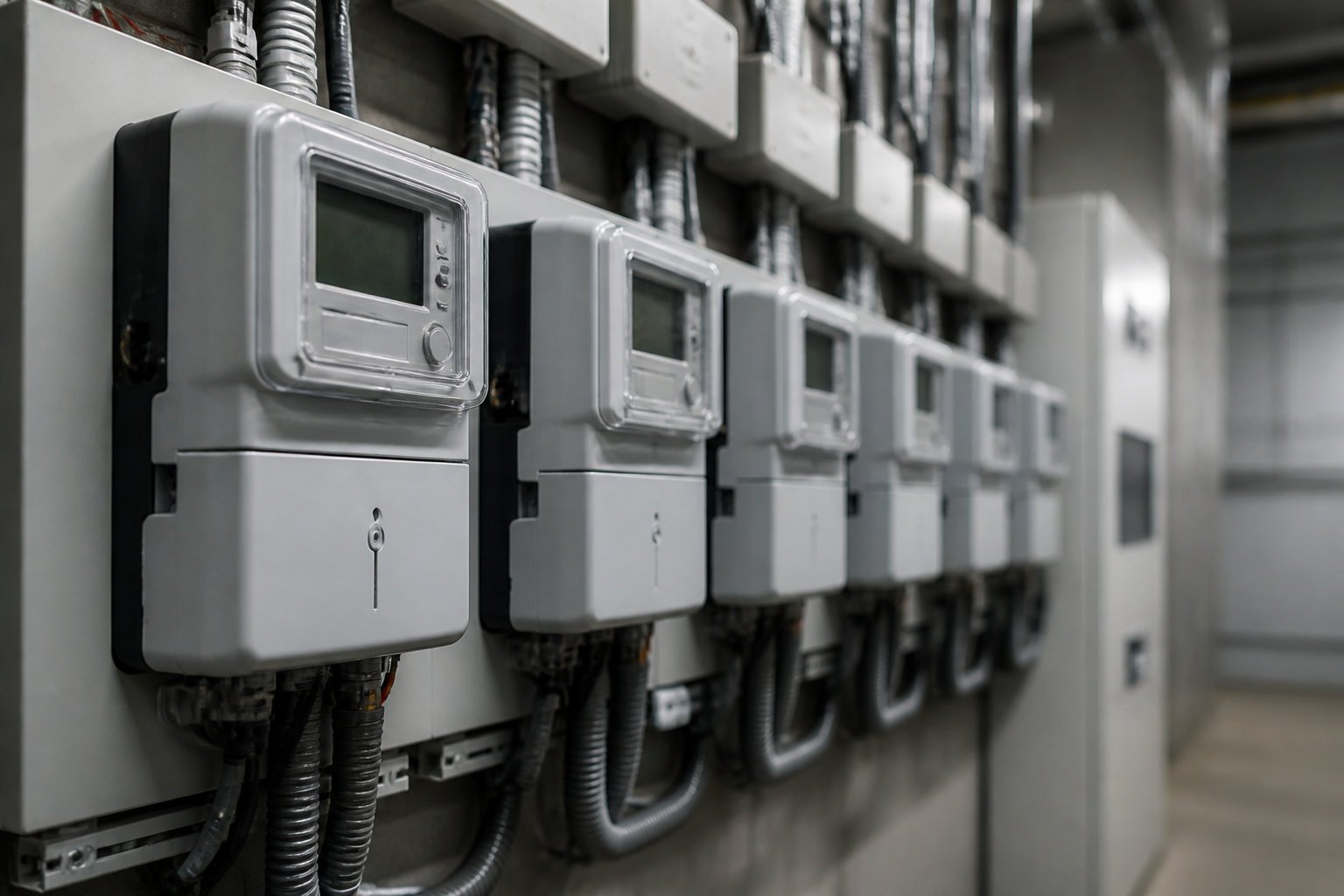
Der intelligente (oder kommunizierende) Zähler ist ein Zweirichtungszähler: Er misst den aus dem Netz bezogenen und den eingespeisten Strom getrennt und kann die Zählerstände aus der Ferne an den Netzbetreiber übermitteln. Diese Fernablesung ist für die Teilnahme an einer gemeinsamen Nutzung von Energie erforderlich. Außerhalb dieses Falls ist sie in Brüssel standardmäßig deaktiviert (außer für Erzeuger) und kann bei ORES auf Ihren Wunsch deaktiviert werden. Ein klassischer Zähler wird vor Ort abgelesen. Um an einer gemeinsamen Nutzung von Energie teilzunehmen, die Viertelstunde für Viertelstunde berechnet wird, braucht jeder Teilnehmer einen kommunizierenden Zähler mit Viertelstundenmessung (oder, in der Wallonie und in Flandern, für bestimmte große Anschlüsse einen fernabgelesenen AMR-Zähler). Ein klassischer Zähler ermöglicht das nicht.
| Kriterium | Klassischer Zähler | Intelligenter Zähler |
|---|---|---|
| Ablesung der Zählerstände | Manuell | Aus der Ferne, wenn die Kommunikationsfunktion aktiviert ist |
| Kosten des Austauschs | Entfällt | Kostenlos bei ORES, Fluvius und Sibelga für den Austausch eines bestehenden Zählers, unabhängig davon, ob Sie an einer gemeinsamen Nutzung von Energie teilnehmen. Für einen zusätzlichen Zähler oder für zusätzliche Arbeiten können Kosten anfallen (Sibelga). Bei RESA, AIEG, AIESH und REW fragen Sie beim Netzbetreiber nach. |
| Aufteilung zwischen den Einheiten | Nicht zulässig | Erforderlich (in der Wallonie und in Flandern ist für bestimmte große Anschlüsse auch ein fernabgelesener AMR-Zähler zulässig), Aufteilung je Viertelstunde durch den Netzbetreiber berechnet |
Die Aufteilung zwischen den Einheiten berechnet der Netzbetreiber (etwa ORES oder RESA in der Wallonie, Sibelga in Brüssel), je Viertelstunde, nach dem von den Teilnehmern gewählten Verteilungsschlüssel. In der Wallonie unterzeichnet ein Vertreter der gemeinsamen Nutzung eine Vereinbarung mit dem Netzbetreiber. In Brüssel wird die gemeinsame Nutzung bei Sibelga gemeldet.
Die Grünstromzertifikate hängen von der Region und der installierten Leistung ab. In Brüssel kann eine Photovoltaikanlage solche Zertifikate erhalten. Für Anlagen, die seit dem 1. April 2026 in Betrieb genommen wurden, ist der von BRUGEL veröffentlichte Vergabesatz über 100 kWp null (Sätze im Oktober 2026 abgerufen). In der Wallonie gibt es seit dem 1. Juli 2018 weder eine Prämie noch Grünstromzertifikate für Photovoltaikanlagen mit einer Leistung von höchstens 10 kW; über 10 kW sind Grünstromzertifikate weiterhin möglich, sofern vor der Umsetzung des Projekts ein Reservierungsantrag beim SPW Énergie gestellt wird. Wir veröffentlichen keine Beträge: Prüfen Sie die aktuellen Bedingungen bei BRUGEL oder beim SPW Énergie.
Regionale Besonderheiten und der Fall der vermieteten Wohnung
Schließlich hängen die geltenden Regeln von Ihrer Region und von Ihrem Status als Bewohner ab.
Regulatorische Unterschiede zwischen der Wallonie und Brüssel
Die Regeln für die gemeinsame Nutzung von Energie unterscheiden sich je nach Region. In Brüssel gibt es drei Formen: von Peer zu Peer, innerhalb desselben Gebäudes und über eine Energiegemeinschaft. Für die gemeinsame Nutzung innerhalb desselben Gebäudes muss keine juristische Person gegründet werden; eine Energiegemeinschaft muss eine Genehmigung von BRUGEL erhalten, bevor sie tätig werden kann.
In der Wallonie werden die gemeinsame Nutzung von Energie innerhalb desselben Gebäudes und die Energiegemeinschaften durch das Dekret vom 12. April 2001 über die Organisation des regionalen Elektrizitätsmarktes, geändert durch das Dekret vom 5. Mai 2022, sowie durch den Erlass der Wallonischen Regierung vom 17. März 2023 geregelt. Für eine gemeinsame Nutzung innerhalb desselben Gebäudes bestimmen die Teilnehmer einen Vertreter und melden die gemeinsame Nutzung beim Netzbetreiber.
Die Schritte unterscheiden sich je nach Region. In der Wallonie wird die gemeinsame Nutzung innerhalb desselben Gebäudes beim Netzbetreiber mit dem von der CWaPE erstellten Formular gemeldet, und etwaige Grünstromzertifikate fallen in die Zuständigkeit des SPW Énergie. In Brüssel wird die gemeinsame Nutzung bei Sibelga gemeldet; die Zertifizierung der Anlage erfolgt über eine zugelassene Zertifizierungsstelle, danach verwaltet BRUGEL die Grünstromzertifikate. In Flandern ist die Regulierungsbehörde die Vlaamse Nutsregulator.
Wallonie: CWaPE (www.cwape.be). Brüssel: BRUGEL (www.brugel.brussels).
Die Förderungen hängen von der Region ab: Lesen Sie unsere Seite Belgien und prüfen Sie die Regelung anschließend auf der offiziellen Website Ihrer Region.
Sehen Sie sich die offiziellen regionalen Websites an. Jedes Energieportal beschreibt seine eigenen technischen Besonderheiten.
Auswirkungen der Solaranlage auf den Mietvertrag
Das Verhältnis zwischen Vermieter und Mieter muss klar sein. Versorgt die Anlage die Gemeinschaftsteile und zahlt der Mieter einen tatsächlichen Anteil an den gemeinsamen Lasten, findet sich die Senkung dieser Lasten in seiner Abrechnung wieder; bei pauschalen Lasten ist das nicht automatisch der Fall. Ist die Anlage am Zähler der Gemeinschaftsteile angeschlossen, senkt der erzeugte Strom die Stromrechnung der vermieteten Wohnung nur, wenn der Mieter an der gemeinsamen Nutzung von Energie teilnimmt, mit einem kommunizierenden oder fernabgelesenen Zähler. In Brüssel ist diese Teilnahme frei und freiwillig. Vor der gemeinsamen Nutzung schließen die Teilnehmer eine Vereinbarung, die die Rechte und Pflichten jedes Einzelnen festlegt, gegebenenfalls auch die Regeln für die Abrechnung des geteilten Stroms.
Prüfen Sie Ihre Vorschüsse auf die Lasten. In der Wallonie entsprechen die vom Mieter gezahlten Lasten, außer bei einer ausdrücklich vereinbarten Pauschale, den tatsächlichen Ausgaben (wallonisches Dekret vom 15. März 2018 über den Wohnungsmietvertrag, Art. 24): Eine Senkung der gemeinsamen Lasten erscheint also in der Abrechnung. Bei einem Mietvertrag über einen Hauptwohnsitz kann jede Partei, wenn die Lasten pauschal sind, den Friedensrichter jederzeit bitten, die Pauschale anzupassen oder in tatsächliche Lasten umzuwandeln. Prüfen Sie in Brüssel und in Flandern, welche Regel für Ihren Mietvertrag gilt.
Lassen Sie den Ausweis nach den Arbeiten von einem zugelassenen Zertifizierer (in Flandern: energiedeskundige type A) aktualisieren, damit er die Anlage berücksichtigt. In Flandern macht die Installation einer gemeinschaftlichen Solaranlage einen neuen EPC für die Gemeinschaftsteile erforderlich. In allen drei Regionen ist bei Verkauf oder Vermietung einer Wohnung ein Energieausweis vorgeschrieben: PEB-Zertifikat in der Wallonie und in Brüssel, EPC in Flandern.
Eine Photovoltaikanlage kann den Energieausweis der Wohnungen auch verbessern, nach Regeln, die jede Region selbst festlegt. In Brüssel berücksichtigt der Zertifizierer sie nur, wenn ein annehmbarer Nachweis belegt, dass die Erzeugung den Bewohnern zugutekommt: der Konformitätsbericht der elektrischen Anlage oder ein Buchhaltungsdokument des Miteigentums. Im Zweifel erwähnt er sie nicht. In Flandern wird eine gemeinschaftliche Anlage in den EPC der Gemeinschaftsteile aufgenommen, dessen Daten zur Erstellung des EPC jeder Wohnung dienen. In der Wallonie fragen Sie den zugelassenen PEB-Zertifizierer, wie die gemeinschaftliche Anlage berücksichtigt wird.
Kurz gesagt: Prüfen Sie den Status des Daches in der Basisurkunde, lassen Sie das Vorhaben mit einem Kostenvoranschlag auf die Tagesordnung setzen, wählen Sie die Variante (nur Gemeinschaftsteile oder Aufteilung auf die Einheiten) und informieren Sie sich vor der Abstimmung über die Regeln Ihrer Region.
Und die finanziellen Förderungen?
Die Förderungen für Photovoltaik sind regional geregelt und wurden in den letzten Jahren überarbeitet: In Flandern etwa ist die Fluvius-Prämie für Solaranlagen für Anlagen abgeschafft, die ab dem 1. Januar 2024 geprüft oder in Betrieb genommen wurden. Jede Region hat ihre eigene Regelung, und was in Brüssel gilt, gilt nicht unbedingt in der Wallonie oder in Flandern. Wir veröffentlichen in diesem Artikel daher keinerlei Beträge. Die für Ihre Region geltende Regelung ist auf unserer Seite Belgien zusammengefasst; prüfen Sie sie auf der offiziellen Website Ihrer Region: energie.wallonie.be für die Wallonie, vlaanderen.be für Flandern, brugel.brussels für Brüssel.