Inleiding tot zonne-omvormers
Omvormers zijn essentiële componenten in elke fotovoltaïsche installatie in België. Ze converteren de gelijkstroom (DC) geproduceerd door zonnepanelen naar wisselstroom (AC) die bruikbaar is voor huishoudens of injecteerbaar op het net. In 2026, met de opkomst van hernieuwbare energie en de EU-doelen voor koolstofneutraliteit, wordt de keuze tussen micro-omvormer en centrale omvormer cruciaal. Volgens gegevens van APERe bestaan er meer dan 150.000 zonne-installaties in België, en dit aantal zal naar verwachting verdubbelen tegen 2030. Deze vergelijking helpt Belgische eigenaars bij het begrijpen van technische, economische en praktische verschillen.
In een context waar subsidies zoals de Qualiwatt-premie in Wallonië of groene certificaten in Brussel investeringen stimuleren, is het begrijpen van deze technologieën key. Bijvoorbeeld, een verkeerd gekozen omvormer kan de energieproductie met 10-20% verminderen bij schaduw. We verkennen de basis, gebaseerd op studies van de Universiteit van Luik en rapporten van ODE. Gebruik onze zonnecalculator om uw installatie te simuleren.
Deze gids is gestructureerd voor een diepgaande analyse: van definities tot cijfervergelijkingen, via lokale toepassingen. Met prijzen in EUR en echte voorbeelden, zoals een installatie van 5 kWc in Brussel, bieden we actionable informatie. Vergeet niet een gratis offerte aan te vragen om uw project te personaliseren.
Trends in 2026 tonen een groei van micro-omvormers met 15% per jaar in de Benelux, dankzij hun flexibiliteit. Maar centrale omvormers domineren nog voor grote zonnefarms. Laten we in detail verkennen.
Om te contextualiseren, herinneren we eraan dat België streeft naar 8 GW zonne-energie tegen 2030, volgens het Nationaal Energie- en Klimaatplan. Dit maakt deze vergelijking des te relevanter voor inwoners van Vlaanderen, Wallonië en Brussel.
Wat is een centrale omvormer?
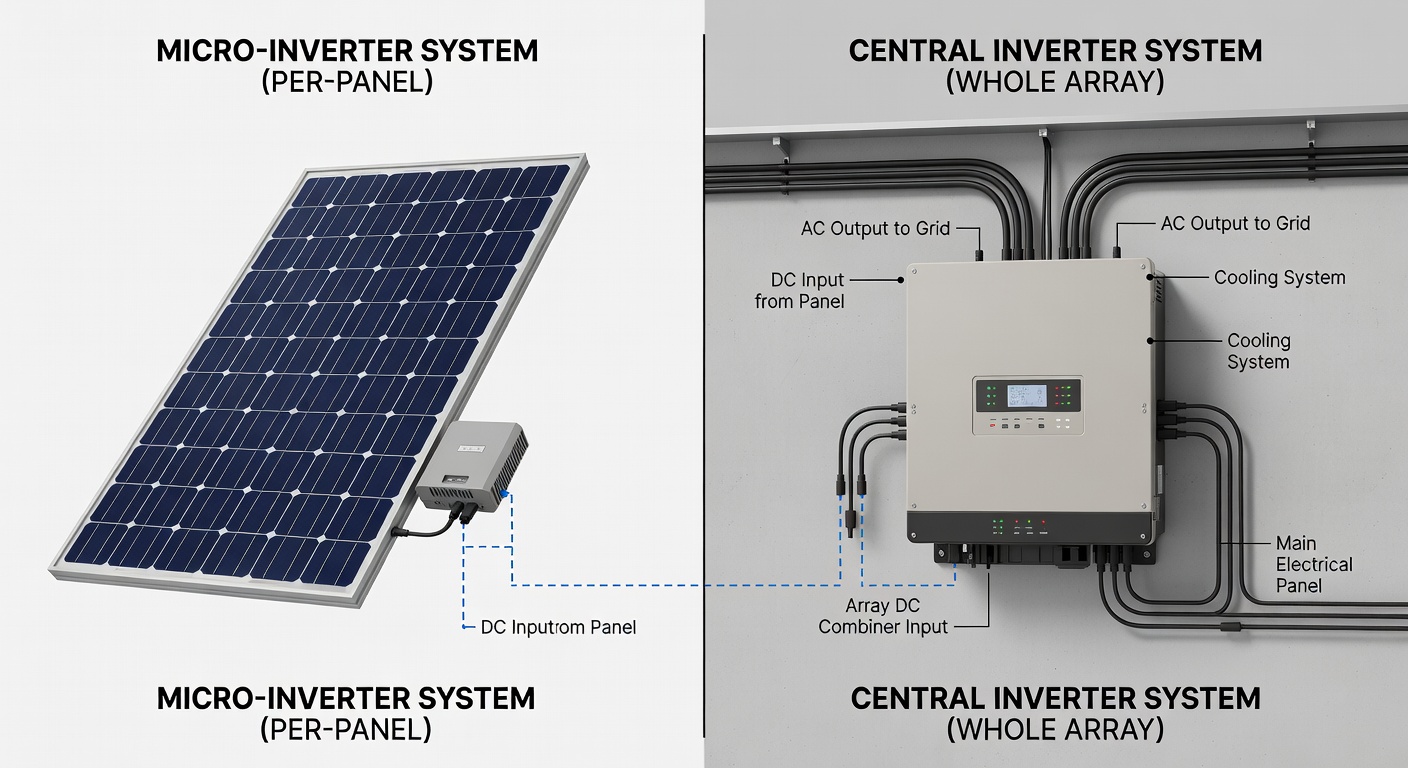
Een centrale omvormer, ook string inverter genoemd, is een enkel apparaat dat alle in serie verbonden zonnepanelen beheert. Het is geplaatst op een centrale locatie, vaak in een garage of kelder, en converteert DC naar AC voor het hele systeem. In België zijn merken zoals SMA of Fronius populair, met modellen zoals de SMA Sunny Boy die een efficiëntie van 97% bieden.
Technisch werkt het op ketens van panelen, wat de bedrading vereenvoudigt maar het systeem gevoelig maakt voor zwaktes van één paneel. Bijvoorbeeld, als een paneel schaduw heeft, verliest de hele keten prestaties. Volgens een studie van IEA-PVPS kan dit een verlies van 5-15% veroorzaken in stedelijke gebieden in België zoals Antwerpen of Luik.
Centrale omvormers zijn schaalbaar: je kunt power optimizers toevoegen om schaduw te mitigeren. In 2026, met CEI 62109 normen, integreren ze vaak monitoringfuncties via apps. Voor een installatie van 10 kWc kost een centrale omvormer ongeveer 2.000-4.000 €, exclusief installatie.
Ze zijn compatibel met batterijen zoals Tesla Powerwall, wat zelfconsumptie vergemakkelijkt. In Wallonië vereist de CWaPE-regulering certificering voor netinjectie, die deze omvormers gemakkelijk voldoen.
Voorbeeld: een huis in Namen met 20 panelen gebruikt een centrale omvormer Fronius Primo, producerend 8.000 kWh/jaar, gebaseerd op echte gegevens uit 2025.
Wat is een micro-omvormer?
Micro-omvormers zijn kleine apparaten geïnstalleerd onder elk zonnepaneel, die DC naar AC individueel converteren. Dit zorgt voor optimalisatie per module, ideaal voor complexe daken in België. Enphase is leider, met zijn IQ8 die 97,5% efficiëntie biedt.
In tegenstelling tot centrale, vermijden ze ketenverliezen: een geschaduwd paneel beïnvloedt de anderen niet. Een studie van SolarEdge wijst op een productieverhoging van 20% in variabele omstandigheden, gebruikelijk in Vlaanderen met frequente regen.
In 2026 integreren micro-omvormers granulaire monitoring via cloud, om pannes per paneel te detecteren. Voor een installatie van 5 kWc, reken op 2.500-5.000 € voor micros, maar met een garantie van 25 jaar vs 10 jaar voor centrale.
Ze integreren perfect met hybride batterijen, zoals die van Sonnen, voor fijne energiebeheer. In België voldoen ze aan Synergrid normen voor netaansluiting.
Voorbeeld: een appartement in Brussel met 8 panelen en micro-omvormers Enphase produceert 3.500 kWh/jaar, geoptimaliseerd ondanks schaduw van naburige gebouwen.
Voordelen en nadelen van centrale omvormers
Voordelen omvatten lagere kosten: 0,2-0,4 €/W vs 0,5-1 €/W voor micros. Ze zijn eenvoudig te installeren, met minder componenten, wat arbeidskosten met 20% vermindert.
Ze beheren hoge vermogens, ideaal voor zonnefarms in Wallonië, waar projecten van 50 kWc SMA Sunny Tripower gebruiken.
Nadelen: gevoeligheid voor schaduw en globale storingen. Als de omvormer uitvalt, stopt de hele installatie, in tegenstelling tot micros.
Minder flexibel voor uitbreidingen: toevoegen van panelen vereist vaak een nieuwe omvormer. In België, met gevarieerde hellende daken, kan dit de efficiëntie beperken.
- Voordeel: Economisch voor installaties >10 kWc.
- Nadeel: Productieverlies bij gedeeltelijke schaduw.
- Voordeel: Gemakkelijk centraal te onderhouden.
- Nadeel: Kortere levensduur (10-15 jaar).
Voordelen en nadelen van micro-omvormers
Voordelen: individuele optimalisatie, verhogend de productie met 15-25% in echte Belgische omstandigheden. Betere veiligheid, omdat ze op lage DC-spanning werken.
Gedetailleerde monitoring helpt subsidies te maximaliseren via bewezen productie. Uitgebreide garantie vermindert langetermijnkosten.
Nadelen: hogere initiële kosten, en complexere installatie met een micro per paneel.
Bij uitval van een micro, is slechts één paneel beïnvloed, maar vervanging kan duur zijn als onder het dak.
- Voordeel: Ideaal voor geschaduwde of verschillend georiënteerde daken.
- Nadeel: Duurder voor kleine installaties.
- Voordeel: Gemakkelijk schaalbaar.
- Nadeel: Meer potentiële storingspunten.
Vergelijking van kosten in 2026
In 2026 variëren prijzen in België: centrale omvormers op 1.500-3.000 € voor 5 kWc, micros op 2.000-4.500 €. Met subsidies is de ROI 4-6 jaar voor beide.
Vergelijkende tabel:
| Type | Initieel Kosten (€) | Onderhoudskosten (10 jaar) | Jaarlijkse Productie (kWh/5kWc) |
|---|---|---|---|
| Centrale Omvormer | 2.000 | 500 | 4.500 |
| Micro-omvormer | 3.500 | 300 | 5.200 |
Micros besparen via betere productie, compenserend de meerkosten in 3 jaar.
In Vlaanderen helpt de premie van 750 €/kWc. Bekijk onze diensten in België.
Voorbeelden: een centrale bespaart 1.000 € initieel, maar verliest 700 kWh/jaar bij schaduw.
Toepassingen en subsidies in België
In Wallonië biedt Qualiwatt tot 1.000 € voor omvormers, begunstigend micros voor complexe daken.
In Brussel valoriseren groene certificaten de geoptimaliseerde productie van micros.
In Vlaanderen straft het prosumer-regime minder efficiënte systemen zoals micros minder.
Voor batterijen integreren beide, maar micros met Enphase IQ Battery zijn ideaal.
- Wallonië: Premie voor 3 kWc min.
- Brussel: 0,15 €/kWh geïnjecteerd.
- Vlaanderen: Ondersteuning voor zelfconsumptie.
Conclusie en advies
Kies micro voor schaduw, centrale voor economie. Gebruik onze offerte.
Zie ook zonnepanelen in België.
Met 2026 regulaties, investeer nu.
Advies: Evalueer uw dak, bereken met onze tool.
De Belgische zonne-energie groeit met 20% per jaar.
Kies voor de hernieuwbare toekomst!